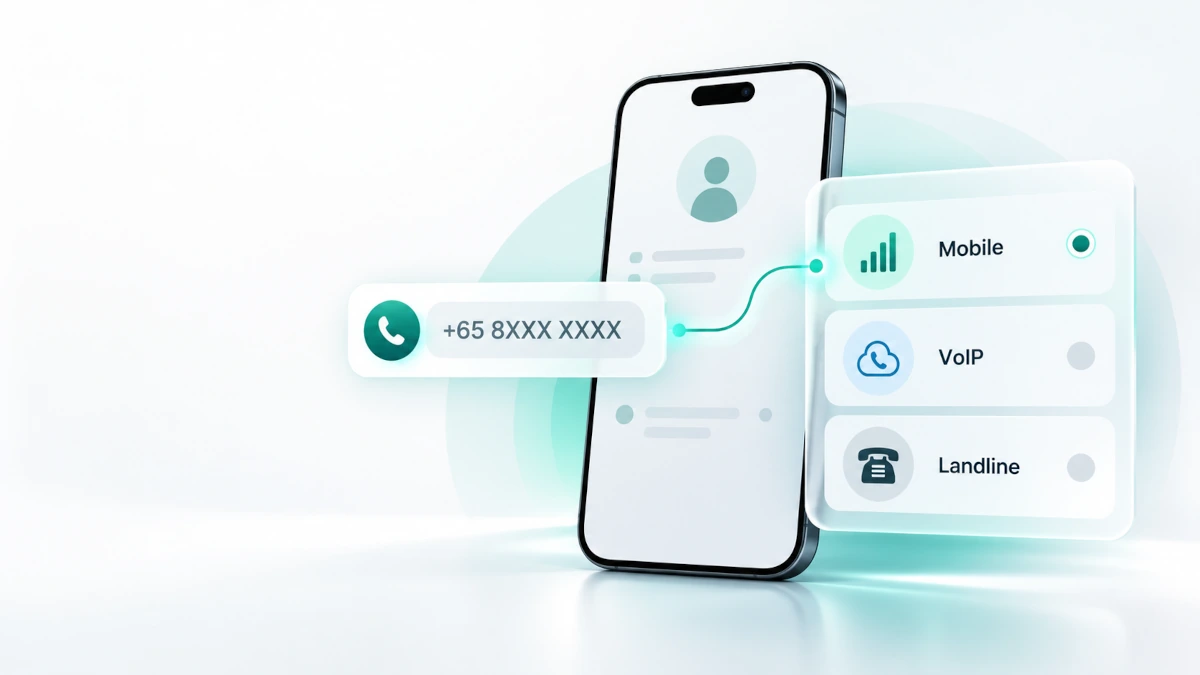
To check whether a phone number is VoIP, mobile, or landline, use a phone-number line-type lookup. A suitable lookup service can classify a number as mobile, fixed VoIP, non-fixed VoIP, landline, or another supported type.
Do not rely on a phone number's country code, appearance, or the fact that its messages arrive in a web browser. Those details cannot reliably establish its telecommunications classification.
There is also a limit to what a successful lookup proves. A result showing mobile does not guarantee that a number is active, that a verification service accepts it, or that an SMS code will arrive.
Here is how to run a meaningful check, read the result, and decide what to do with the information.
Start by Asking the Lookup the Right Question
Phone-number tools are often marketed under similar names, but they do not all check the same thing.
A formatting checker, a carrier lookup, and a network-status service may return different information about the same number.
Check | What it can tell you | What it cannot establish |
|---|---|---|
Format validation | Whether the number follows a recognized numbering pattern | Whether the number is currently assigned |
Line-type lookup | Whether a provider classifies it as mobile, VoIP, landline, or another type | Whether a particular app will accept it |
Network-status lookup | Whether the line appears active or reachable, where supported | Whether a specific verification SMS will arrive |
Actual verification workflow | Whether the receiving service permits and completes that specific attempt | Whether the number will remain accepted in the future |
This difference matters when choosing a checking tool.
A free number validator might display a green check beside a properly formatted number. That does not necessarily mean it has performed a carrier or VoIP classification.
Similarly, a carrier name displayed without a line-type result may not be enough to distinguish mobile from internet-based telephony.
A line-type lookup is a classification of the number, not a receipt confirming that a verification text reached an inbox.
How to Check Whether a Number Is Mobile or VoIP
You do not need to understand the entire telecommunications network to perform a useful check. You do need a trustworthy source and the correct field in its response.
Step 1: Prepare the number in international format
Start with a number you control or are authorized to assess.
Include the correct country calling code. Most lookup APIs accept E.164-formatted international numbers, such as a plus sign followed by the country code and national number.
Do not guess the country from the number's visual appearance. Some regions share international calling codes, while domestic prefixes and national dialing rules vary.
If the lookup service accepts national-format numbers, make sure its country selector is set correctly.
Step 2: Choose a provider that actually returns line type
Look for a service that explicitly offers line-type intelligence, phone type detection, or an equivalent carrier-classification feature.
A useful result should distinguish at least mobile, landline, and VoIP, although some providers offer more detailed categories.
Examples of documented services include Twilio Lookup, Telesign Phone ID, and other established phone-intelligence providers.
Check the service's pricing, country coverage, privacy policy, and permitted use before submitting a number.
For example, Twilio's Basic Lookup validates and formats numbers, while its separate Line Type Intelligence package supplies the detailed classification and is a paid feature.
Do not assume that a website advertising a “free carrier checker” includes current VoIP classification or live network status.
Step 3: Run the line-type request
Follow the provider's current instructions for its web tool, dashboard, or API.
For a technical example, Twilio Lookup v2 accepts a request to its phone-number endpoint with the field:
Fields=line_type_intelligence
The documented response contains a line_type_intelligence object, including a type value. Carrier details and mobile network codes may also be included when available.
A developer using this API must authenticate using their own credentials. Credentials should be protected on the server, not embedded in public website code.
This is an example of a documented lookup method, not an OTP Pool feature or a claim that a live lookup was performed for this article.
Step 4: Read the type field before the carrier name
The most important field for this question is the returned classification.
A carrier name can be helpful context, but it should not replace an explicit mobile/VoIP/landline type result.
Do not infer that a number is mobile solely because the provider has a familiar telecommunications brand name.
Treat a provider name as a clue, not a substitute for the line-type field.
Step 5: Record the result and its limitations
For a consequential decision, note the lookup provider, the time of the check, the exact classification field, and any missing or error values.
You do not need to publish the full phone number or reveal it in screenshots.
A lookup made months ago may be less relevant after number porting, service changes, or provider-data updates.
Reading Mobile, Fixed VoIP, Non-Fixed VoIP, and Unknown Results
Different lookup services use different labels. Twilio's Line Type Intelligence documentation provides a useful example of the range of classifications.
Reported type | General interpretation | What to check next |
|---|---|---|
| Classified as a mobile number | SMS capability, sender rules, and current access |
| Fixed VoIP service associated with a physical service arrangement | Whether the intended platform permits this type |
| VoIP service that does not require a fixed physical device | Whether the intended workflow accepts VoIP |
| Fixed-line telephone classification | Whether a separate SMS or voice capability is supported |
| Toll-free number category | Actual messaging capabilities and intended use |
| The provider cannot determine the line type from the available result | Coverage, error details, and additional evidence |
Other classifications may include personal, premium-rate, shared-cost, pager, voicemail, or universal-access numbers.
Does mobile mean non-VoIP?
For many practical SMS discussions, mobile and non-VoIP are used together. But they are not perfectly interchangeable terms.
A landline can also be non-VoIP. Meanwhile, the word virtual describes how a number or service is offered, not necessarily the type reported by a telecommunications lookup.
That is why a product advertised as a “non-VoIP number” still needs a specific classification check when mobile status matters.
For a broader explanation of the terminology, see what non-VoIP numbers mean.
Can VoIP numbers receive text messages?
Some can. Others cannot.
VoIP classification identifies a type of telephone service; it does not establish every feature of the particular number.
Even when a VoIP number supports incoming SMS, a separate verification application may choose not to accept it.
Conversely, a mobile-classified number may still fail because the sender has a country restriction, an account rule, or another technical limitation.
What if the result says unknown?
Do not interpret unknown as secretly mobile or secretly VoIP.
It means the classification is unresolved in that particular result. The provider may have insufficient data, limited coverage, or another processing limitation.
Check the response's error information and the lookup service's country coverage. If the distinction is important, seek another appropriate source or ask the number provider for clarification.
When a tool displays unknown, the honest conclusion is missing evidence—not that the number is secretly VoIP.
Why Two Phone-Number Checkers May Disagree
Two services can return different classifications without either result proving that the number itself changed at the moment of your checks.
This can happen because their databases, collection methods, update schedules, and country coverage differ.
Number ranges are not the entire story
Numbering authorities allocate blocks of telephone numbers to providers and service categories.
A lookup based mainly on the original allocation can provide useful information. But depending on the market, number portability or subsequent changes may make the current service different from what older range data suggests.
The presence and detail of portability records vary by country.
Lookup databases can become outdated
Numbering-plan changes and carrier updates do not always reach every provider simultaneously.
Twilio maintains a documented Line Type Override capability for correcting incomplete or inaccurate classifications within its lookup system. That is a practical reminder that classification data is not infallible.
A correction made in one provider's system does not automatically update every other lookup database.
Carrier names need context
A returned carrier name may identify a network, an original allocation, a wholesale provider, or another relevant telecommunications entity, depending on the product.
It does not necessarily identify the person who owns the number or prove the device currently receiving its messages.
If two reports disagree, compare which data products they used rather than automatically trusting the most detailed-looking result.
Is the Number Active? That Requires a Different Check
A mobile classification is not a live connection test.
A line-status product may offer a separate assessment of whether a mobile number is active or reachable.
Twilio's Line Status feature, for example, distinguishes several states:
Status | General meaning |
|---|---|
Active | Assigned and active, but not necessarily reachable at that moment |
Reachable | The network reports the handset or line is reachable |
Unreachable | The number is active but not presently reachable |
Inactive | The number is invalid or not assigned to an active mobile subscriber |
Unknown | The provider cannot determine the status |
These are provider-specific definitions and are subject to network and country coverage.
The Line Status feature was introduced as a public beta in 2026. Its results should not be presented as universally available or as guarantees of future message delivery.
Even a reachable number may fail to receive an OTP from a particular application because the sender may not permit that number type, country, or account context.
Keep three results apart: valid structure, classified service type, and actual deliverability.
Why a Mobile Result Does Not Guarantee SMS Verification
The app requesting verification makes its own eligibility decisions.
A line-type report can provide evidence about the number. It cannot override the application’s account policies.
A number classified as mobile might still be rejected because of its supported region, previous use, account history, resend restrictions, or other platform-specific conditions.
Similarly, an SMS may be requested successfully and still fail to arrive through the relevant sending and receiving route.
Match the next action to the actual symptom
What happened | Most useful next action |
|---|---|
Lookup says the number format is invalid | Correct the country code or number entry |
Lookup reports a VoIP classification | Check whether the intended service permits that type |
Lookup reports mobile, but the app rejects the number | Review the app's eligibility rules; don't assume the lookup is wrong |
App accepts the number, but no code arrives | Investigate sender, SMS route, retry timing, and receiving inbox |
Lookup says unknown | Check the provider's coverage and evidence before deciding |
The number is temporary and access has expired | Review the activation or rental status and official recovery options |
If an application rejects a number, a mobile label cannot overrule the application's own registration policy.
For delivery problems, use OTP Pool's separate guide on why verification codes may not arrive. It follows the request through sender, network, and inbox failure points.
Turn the Lookup Into a Useful Decision
The value of a lookup is not merely receiving a technical label. It is understanding which decision that label supports—and which decisions still require more information.
Before using a number for an SMS verification workflow, consider three final questions.
Is this number type permitted?
Check the application’s current official requirements. Avoid relying on claims that one number category or provider works for every platform.
If the receiving service specifically excludes VoIP, a number classified as VoIP may be unsuitable regardless of its ability to receive ordinary messages.
Is the receiving arrangement appropriate?
A private activation is different from a public SMS inbox. Messages in a public inbox may be visible to other people, even if the number itself is classified as mobile.
A private one-time activation also differs from a rental that offers access over a defined period.
The temporary phone number guide explains these access models, while the public SMS inbox safety guide covers confidentiality risks.
Will you need the number again?
Short-term receiving access can end before a later login or account recovery attempt.
If future access matters, use a recovery method that you can maintain under the relevant service's rules.
Where a supported service-and-country combination is available, OTP Pool's SMS verification catalogue lets you review current routes. The catalogue does not independently certify the line type of every listed number or guarantee third-party acceptance.
Before paying for another route, identify which question the previous lookup answered and which question remains open.
The Result Worth Keeping
A useful phone-number check produces a limited, understandable finding.
A format validator can identify a recognized numbering pattern. A line-type lookup can classify the service category. A separate network-status product may provide more information about current reachability.
None of these results proves that a specific application will accept the number, that an OTP will be delivered, or that access will remain available months later.
When interpreting a VoIP or mobile lookup, keep the result, its source, its timestamp, and its limitations together.
A trustworthy conclusion is not the most confident-looking label. It is the conclusion the available evidence actually supports.
Questions and answers
How can I check if a phone number is VoIP?
Use a reputable line-type lookup service that explicitly returns mobile, VoIP, landline, or other number categories. Enter the authorized number in the expected international format and inspect the returned type field rather than relying only on a validity check.
Can I check if a number is VoIP for free?
Some tools offer free checks, trials, or limited lookup allowances, but their coverage and fields vary. A free formatting result may not include VoIP classification. Twilio's Basic Lookup is free, while its separate Line Type Intelligence feature is paid.
What does a mobile result mean in a carrier lookup?
It means the lookup provider classifies the phone number as mobile. It does not prove the number is currently reachable, that a particular service permits it, or that a verification SMS will arrive.
What is the difference between fixed VoIP and non-fixed VoIP?
Fixed VoIP is generally associated with a physical service arrangement, whereas non-fixed VoIP does not require a fixed physical device or location in the same way. Both are VoIP classifications, and acceptance depends on the receiving application's requirements.
Can a mobile number be used for VoIP calls?
A telephone service may use internet-based calling technology while its phone number retains a mobile classification. The calling technology and the line type returned by a lookup are related but not identical concepts.
Why do two carrier lookup websites show different results?
Providers can use different data sources, update schedules, portability information, and country coverage. One classification may also be incomplete or outdated. Compare the exact result fields and the provider's coverage before making a decision.
What does unknown mean in a phone-number lookup?
Unknown means the provider cannot classify the number using the information available for that request. It does not prove the number is VoIP, mobile, invalid, or fraudulent. Check for errors and coverage limitations.
Will a non-VoIP or mobile number always receive verification codes?
No. The application may apply country, account, number-type, and anti-abuse rules. Message delivery also depends on the sending route and receiving access. A mobile classification is only one piece of evidence.
Sources and references
- libphonenumber FAQ · Google — Official explanation of phone-number validation and why a valid range does not prove that a number is assigned or reachable.
- Lookup v2 Quickstart · Twilio — Documents free Basic Lookup and paid Line Type Intelligence.
- Line Type Intelligence · Twilio — Defines mobile, fixedVoip, nonFixedVoip, landline, unknown, and other lookup classifications.
- Line Status · Twilio — Documents active, reachable, unreachable, inactive, and unknown mobile network statuses.
- Line Type Override · Twilio — Explains how incomplete or inaccurate line-type classifications can be corrected within the service.
- How Can I Detect Anonymous VoIP Numbers? · Telesign — Technical discussion of VoIP detection, carrier data and phone-type identification.