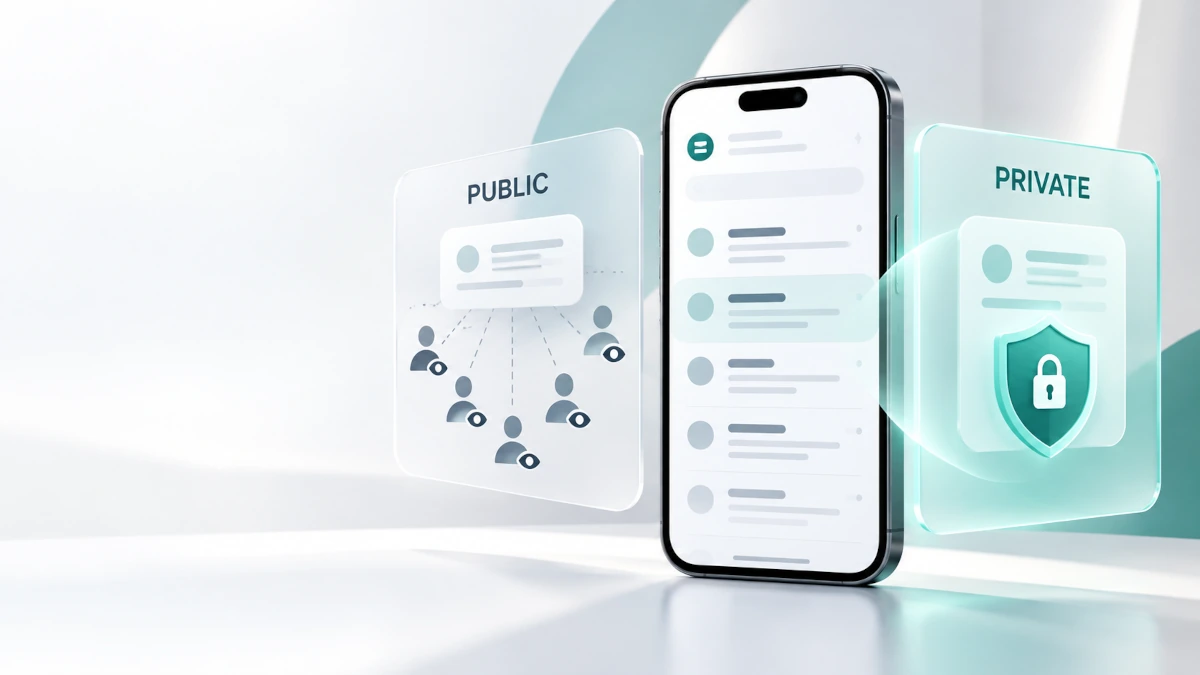
Free SMS numbers can receive real text messages, but they are not automatically safe for private communication. If the number uses a public online inbox, other visitors may be able to read its messages—including verification codes, sign-in links, or account-recovery instructions.
A free public number can keep your everyday phone number off a registration form. That is different from keeping the received message confidential.
The safest choice depends on three things: what the message contains, who can view it, and whether you need to regain control of the number.
A Public SMS Number Protects One Detail, Not Every Detail
Consider two separate privacy questions.
The first is whether a website receives your personal mobile number. Using a different number can reduce that particular disclosure.
The second is whether the incoming SMS remains accessible only to you. A public inbox does not provide that protection.
A public SMS service publishes a receiving number and makes its associated messages available through a shared web page. The messages may be genuine texts delivered through a telecommunications route, even though the inbox is publicly accessible.
A number being free does not automatically mean it is public. Some services may offer promotional access to private numbers. The important distinction is the access arrangement, not the price.
What a shared inbox can reveal
Depending on the sender, an SMS might disclose:
The name of a service sending a message.
A one-time verification code.
A sign-in or password-reset link.
Part of an account identifier or transaction reference.
Information about an account-related event.
Not every message contains sensitive information. Not every exposed code can be used independently to access an account. Additional authentication checks, expiry times, and session binding may limit what another person can do.
Nevertheless, if the message is intended to be confidential, a publicly readable inbox is the wrong destination.
To see how the shared access model works, review OTP Pool's free public SMS numbers. These numbers can receive real SMS, but their inboxes may be visible to other visitors.
Read the Risk in the Message, Not the Number's Price
A text message is not automatically harmless because it contains only a short string of digits. Equally, not every public SMS creates the same level of exposure.
The message's purpose matters more than the number's cost.
Message category | What may be exposed | Appropriate use of a public inbox |
|---|---|---|
Non-sensitive test message | Fictional or deliberately harmless test content | Potentially acceptable in an authorized test |
Routine service notification | Sender identity, event information, or personal details | Only if the content is genuinely non-sensitive |
Registration verification code | A code associated with account creation | Avoid for accounts requiring confidentiality or continued control |
Sign-in or authentication code | A temporary authentication secret | Not appropriate |
Password-reset or recovery link | A link that may authorize account access or recovery | Not appropriate |
Financial or identity-related message | Potentially sensitive personal or transaction information | Not appropriate |
This is a content-sensitivity guide, not a claim that every sender implements security in the same way.
A verification code may be more than a set of digits
A code is valuable because a service has assigned meaning to it.
Some verification systems require the correct code within the same browser session. Others combine it with an account password or another check. Still others may allow a code to complete an account-related action once the appropriate request has been initiated.
The risk depends on those controls. The safest assumption is that an active authentication code should remain confidential, even when additional protection might exist.
A link may reveal more than an OTP
Some SMS messages contain URLs that perform or continue sensitive actions.
A link can be designed merely to open a public information page. But a bearer-style link may carry a token that grants access without requesting another secret. If that link appears in a public inbox, anyone who can read it may be able to open it while it remains valid.
That is not a hypothetical limitation of the SMS format alone. It depends on how the destination service designs its link authentication.
Research into SMS-delivered URLs has documented cases in which exposed links provided access to sensitive information. The consequences were caused partly by inadequate authorization checks at the linked services.
For messages involving private accounts, do not send such links to shared inboxes.
Message Exposure Has a Timeline
The risk of using a public number does not always end when you finish entering a code.
It changes over time.
While the message is valid
A publicly displayed authentication message may be readable by someone else during its usable period.
Whether that person can act on it depends on the sender's verification design and other protections.
A short expiry period reduces the time available for misuse, but it does not turn a publicly visible secret into a private one.
After the immediate verification
Some inbox operators may retain messages or make recent history available. The display and retention rules vary.
An expired OTP might no longer work as a credential, yet the message can still disclose which service was involved or contain other information that remains relevant.
Do not assume deletion, confidentiality, or permanent availability unless the provider's actual policy supports that expectation.
When another SMS is needed months later
This can be the more persistent problem.
An account may stay linked to the number long after the original verification has finished. A future login challenge, security review, or recovery attempt might send a fresh message to that same destination.
If you no longer control the number—or if its inbox remains public—you may not be the only person able to view the new message.
A temporary number is not an appropriate long-term recovery channel for an account you need to keep secure.
The difference between public access, private activation, rental duration, and ongoing number control is explained in what a temporary phone number is.
What Research Tells Us About Public SMS Gateways
Security researchers have studied public SMS services rather than relying only on anecdotal reports of failed verification codes.
A 2023 paper, Your Code is 0000: An Analysis of the Disposable Phone Numbers Ecosystem, examined 17,141 disposable phone numbers across 29 public SMS gateways over approximately 12 months. Its dataset contained more than 70 million messages.
The findings show why public receiving systems deserve scrutiny: they can expose large quantities of SMS activity and can be misused in account-related workflows.
A separate 2026 study, Private Links, Public Leaks, analyzed more than 322,000 unique SMS-delivered URLs extracted from more than 33 million messages. The researchers identified and validated sensitive-information exposure in 701 endpoints associated with 177 services.
These numbers describe the researchers' datasets and findings. They are not OTP Pool usage statistics, delivery rates, or evidence that every SMS provider has the same vulnerabilities.
The useful lesson is narrower and more practical: a message's security depends both on who can read it and on what the sending service permits someone to do with its contents.
The broader authentication problem is also reflected in NIST's Digital Identity Guidelines, which classify telephone-network-based out-of-band authentication as a restricted authenticator. An authentication method should not be assumed secure solely because it sends a code by SMS.
When Does a Free Public SMS Inbox Make Sense?
There are legitimate situations in which public message visibility is acceptable.
The clearest case is testing a system you own or are authorized to test, using messages intentionally designed to contain no confidential data.
For example, a development team may need to observe whether a non-sensitive test notification reaches an SMS destination. If no real login credentials, customer details, recovery tokens, or meaningful personal information are involved, the confidentiality requirement may be minimal.
That does not mean every public number will accept every test message. The sender and receiving route still need to support the workflow.
Apply a three-question check
Before using a public inbox, ask:
Would it matter if someone else read the complete message?
If the answer is yes, do not use a public inbox.
Could the message help someone access an account or discover private information?
If the answer is yes or uncertain, choose an appropriately protected channel.
Will this account or workflow need the same number in the future?
If the answer is yes, a freely shared or short-lived number may not provide adequate continuity.
When none of these concerns applies and the use is permitted, a public inbox may be reasonable for the limited task.
What Private SMS Access Changes—and What It Cannot Promise
A private activation changes the visibility arrangement.
Instead of publishing a message to a shared feed, the provider associates supported incoming SMS with the customer's active order or account.
That reduces exposure to unrelated visitors. It does not automatically guarantee secure account recovery, permanent ownership, or acceptance by every third-party service.
A private activation and a rental also serve different needs.
Access option | Message visibility | Access duration | Main limitation |
|---|---|---|---|
Public number | Shared or publicly viewable | Provider-dependent | No confidential inbox |
Private one-time activation | Account-restricted during the order | Limited activation window | Not designed for ongoing number control |
Private rental | Restricted during the rental | Defined rental period | Access can end when the rental ends |
Continuing personal mobile service | Controlled through an ongoing service arrangement | Subject to maintaining service | Still requires account security and recovery planning |
Private does not mean invisible to every system involved in transmitting or processing the SMS.
It also does not mean anonymous. A service may collect information beyond the phone number, and a number provider may process operational records under its policies.
When a private receiving workflow is genuinely needed, review the available SMS verification options. Check the actual service, country, access window, and third-party acceptance rules.
If longer access is necessary, compare temporary and rental number options before committing to a short-term activation.
Already Used a Public Number? Protect the Account You Control
If an important account is linked to a public SMS number, there may be a way to improve its security without waiting for a problem.
Start within the service's official account settings.
Replace the shared recovery number
Where the service permits it, replace the public number with a phone number you control on an ongoing basis.
Do this while you still have authorized access to the account. Do not assume you will be able to complete the change after losing your current sign-in method.
Configure stronger recovery options
Use supported passkeys, an authenticator app, backup codes, or another secure recovery method where available.
Store recovery codes in a protected location. Do not place them in shared documents, public messages, or an SMS inbox that strangers can read.
Review important account activity
Check the service's own security dashboard for unfamiliar sessions, recent account changes, or unexpected recovery requests.
If the account may already be compromised, use its official security or account-recovery process. Follow the platform's instructions for revoking unauthorized sessions and updating credentials.
Stop sending sensitive messages to the old number
Removing a number from one account does not automatically remove it from every other account where you may have used it.
Review those associations individually. Avoid repeatedly requesting new codes to an inbox you no longer trust.
If the immediate issue is that a code never arrived, use the separate guide on verification codes not being received. That is a delivery problem, not necessarily a confidentiality problem.
The Safest Number Is the One That Fits the Message
A free public SMS number can be useful without being suitable for private authentication.
The distinction is not whether the text message is real, whether the number looks like a normal mobile number, or whether access costs money.
It is whether the message can safely be observed by other people and whether you will retain the access needed for future account security.
For deliberately non-sensitive testing, public visibility may be acceptable. For login secrets, recovery links, financial information, and accounts you intend to keep, use an appropriately private and durable recovery arrangement.
Protecting your personal phone number and protecting your incoming messages are separate decisions. Both matter.
Questions and answers
Are free SMS numbers safe for verification?
It depends on the access arrangement and the message's purpose. A free public SMS inbox may expose verification messages to other visitors, so it should not be used for sensitive accounts, authentication secrets, or important recovery workflows.
Can other people see messages sent to a public SMS number?
Yes. A public inbox may display incoming texts to anyone who opens its page. Message retention and visibility vary by provider, so never assume a publicly accessible receiving number offers confidential communication.
Can someone access my account just by seeing an SMS code?
It depends on how the service verifies requests. Some codes are tied to a session or require additional checks. Others may complete an account-related action when presented in a valid workflow. Treat active authentication codes as confidential.
Are SMS login and password-reset links dangerous in a public inbox?
They can be. Some links contain access tokens that authorize sensitive actions without another password. A publicly visible link may therefore expose access or personal information, depending on the sender's security controls.
Does a private temporary number guarantee account safety?
No. Private access reduces message exposure to unrelated visitors during the assigned period, but it does not guarantee SMS delivery, platform acceptance, anonymity, or permanent ownership of the number.
What happens if a public or temporary number is reused later?
A number may remain associated with an account after the original user stops using it. Later SMS challenges or recovery messages can create security or access problems if the user no longer exclusively controls the receiving number.
When is it reasonable to use a public SMS inbox?
A public inbox may be appropriate for authorized testing or other deliberately non-sensitive messages where disclosure has no meaningful consequence, future access is unnecessary, and the sender permits the receiving arrangement.
What should I do if an important account uses a public SMS number?
While signed in through an authorized session, review the platform's security settings, replace the number with a recovery channel you control, enable stronger authentication where available, and check for unfamiliar account activity.
Sources and references
- Your Code is 0000: An Analysis of the Disposable Phone Numbers Ecosystem · Moreno et al., research paper — Research into the public SMS gateway ecosystem, disposable numbers, and large-scale message activity.
- Private Links, Public Leaks: Consequences of Frictionless User Experience on the Security and Privacy Posture of SMS-Delivered URLs · Danish et al., research paper — Research into security and privacy risks associated with SMS-delivered links and token-based access.
- NIST SP 800-63B — Authentication and Authenticator Management · National Institute of Standards and Technology — Official guidance on authentication risks and restrictions for telephone-network-based authentication.
- Free Virtual Phone Numbers to Receive SMS Online · OTP Pool — Defines OTP Pool's public-number access model and visibility warnings.
- Temporary Phone Numbers for SMS Verification · OTP Pool — Explains the available temporary, private activation and rental workflows.