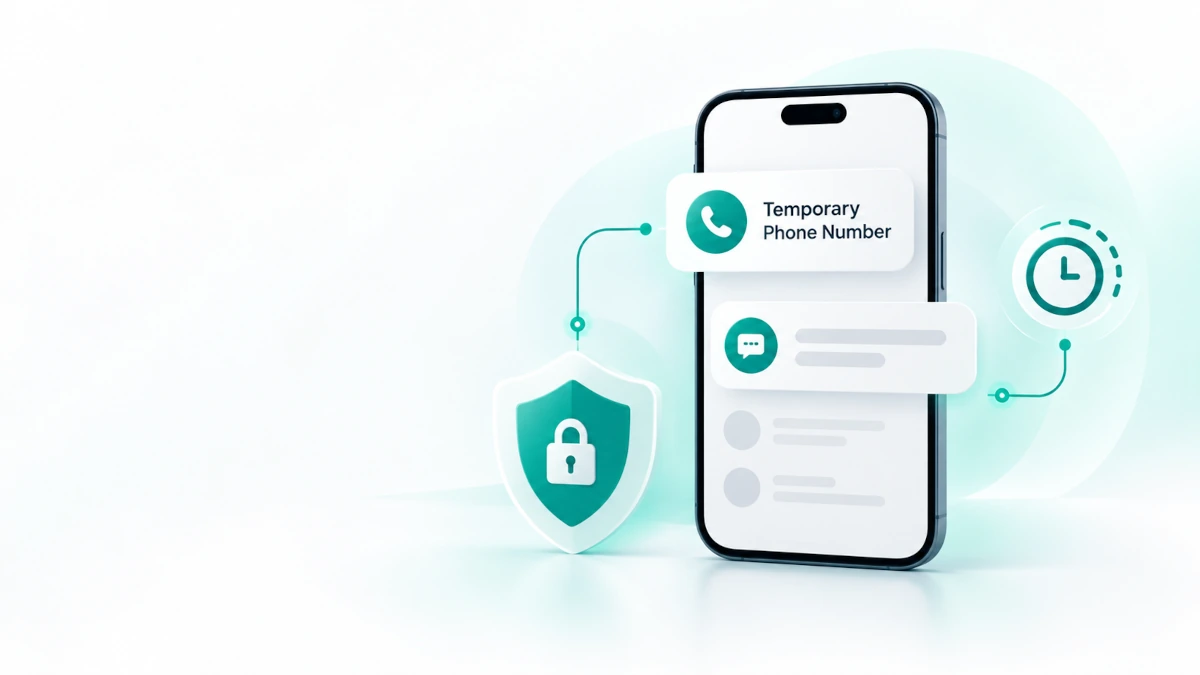
How Does a Temporary Phone Number Work?
When someone sends an SMS to a temporary number, the message travels through the relevant telecommunications and messaging infrastructure. The number provider then makes an eligible incoming message available through an online inbox, dashboard, or application.
The underlying number might be associated with mobile-network infrastructure or an internet-based telephone service. A temporary number does not always mean VoIP, and not every virtual number supports the same communication features.
For a typical SMS-only activation, the process follows four stages:
Select a supported number. Choose an available country or service, depending on the provider's options.
Use the assigned number. Enter it where a supported application requests an SMS-capable telephone number.
Receive the message. If the sender accepts the number and the SMS is delivered, it becomes available in the designated inbox.
Finish within the access period. The activation ends according to the provider's rules, and further access may no longer be possible.
An active number does not guarantee message delivery. The sending platform, carrier routing, number type, previous use, and provider restrictions can all affect the outcome.
Providers also differ in whether they support incoming calls, outgoing messages, repeated verification codes, or multiple services. Those capabilities should be checked individually.
What Makes a Temporary Number Different From a Regular Phone Number?
The main difference is the intended duration and control of access.
Your regular mobile number is generally associated with an ongoing service arrangement. You can normally continue using it while your account remains active, making it appropriate for personal communication and long-term account recovery.
A temporary number has a narrower purpose. It might remain accessible for a short activation window or a purchased rental period.
There is also an important distinction between number ownership and inbox access. Being assigned a number temporarily does not mean you legally own it or can transfer it to another provider.
Temporary, virtual, public, and rental numbers are not identical
The terms are often used interchangeably, but they describe different properties.
Number type | Main characteristic | Typical access |
|---|---|---|
Temporary number | Intended for limited use | Short-term |
Virtual number | Describes how the number is provided or managed | Varies |
Public SMS number | Messages are available through a shared inbox | Public or shared |
Private activation number | Inbox access is restricted during an activation | Limited session |
Rental number | Access continues for an agreed rental period | Defined duration |
Regular mobile number | Ongoing carrier-based service | Long-term while active |
A virtual number can be temporary or long-term. A temporary number can be public or private. Renting a number may give you continued access, but it does not necessarily make the number permanent.
That is why the provider's actual access policy matters more than the product label alone.
When Is a Temporary Phone Number Useful?
Keeping your everyday number separate
Giving your personal number to unfamiliar websites can expose it to future contact, marketing messages, or unwanted communication.
A separate temporary number can reduce how often you disclose your everyday number. However, it does not prevent a platform from identifying you through other information associated with your activity.
Receiving a supported one-time verification code
Some applications request an SMS code to confirm control of a phone number.
A private temporary number may be suitable when the service allows it, the route supports the requested message, and future access to that number is unnecessary.
If repeated verification or account recovery is likely, short-term access is a poor fit.
For supported one-time workflows, SMS verification options can be compared by country and service before obtaining a number.
Testing SMS-enabled applications
Developers and QA teams may need to test number formatting, message delivery, verification screens, timeout handling, and user-facing error messages.
Test environments should ideally use official sandbox numbers or approved testing arrangements. Temporary numbers can be useful for authorized live testing when the necessary permissions and platform rules allow it.
Short-term communication
Some number providers offer calling and messaging features for temporary business inquiries, listings, or short-lived projects.
These capabilities are not universal. An SMS-receiving number should not be assumed to support voice calls or two-way conversations.
Does a Temporary Phone Number Protect Your Privacy?
A temporary number can help keep your primary phone number out of a particular interaction. That is a practical privacy benefit, but it has limits.
Privacy is not the same as anonymity.
A website may still collect your email address, IP address, device information, payment details, or other account information. A number provider may also maintain records subject to its policies and legal obligations.
The number itself may have been used previously or may be reassigned later. For example, the U.S. FCC documents number reassignment to new users.
Public inboxes have a different privacy model
A public SMS inbox is designed to display received messages openly or to multiple visitors.
That makes public numbers unsuitable for confidential messages, personal accounts, financial services, password resets, or anything that could expose sensitive information.
Someone who can view the same inbox may see incoming codes or messages. Public numbers may also be heavily reused, which can affect acceptance by different services.
A public SMS number should therefore be limited to non-sensitive purposes where shared visibility is acceptable.
Private access is better, but not permanent ownership
A private activation restricts access to messages during the assigned session. That is materially different from a publicly accessible inbox.
However, private access does not guarantee future control of the number, permanent storage of messages, or successful account recovery after the activation expires.
For sensitive or important accounts, a number you can retain reliably is generally more appropriate.
What Happens When a Temporary Number Expires?
Expiry is one of the most important limitations of temporary-number services.
When your access ends, you may no longer be able to receive new SMS messages sent to that number. The provider may return the number to inventory, deactivate it, or make it available through another arrangement.
The exact process varies.
This creates a potential account-recovery problem. A website might ask you to verify the same phone number again days or months after registration.
If you no longer control that number, a new verification code may become inaccessible to you.
A previously received code does not establish permanent control over the phone number.
Before using a temporary number, consider three questions:
Will this service ask for another SMS when I sign in?
Will I need this number for account recovery?
What happens if I lose access to the number?
If the account is valuable, contains sensitive information, or must remain accessible indefinitely, avoid relying on a disposable number as its only recovery method.
Where supported, configure secure alternative recovery methods before access ends. NIST guidance treats SMS verification over the public telephone network as a restricted authentication method and calls for alternatives.
How Do You Choose Between a Public, Temporary, and Rental Number?
The best option depends on message sensitivity and how long the number must remain available.
A public number can be appropriate for non-sensitive testing when it is acceptable for other people to view received messages.
A private temporary activation is more appropriate for a supported short-term verification when access to the inbox should be restricted and no later SMS is expected.
A rental number is more suitable when the same number may be needed again during a defined period. It provides more continuity than a one-time activation but should not be treated as permanent.
OTP Pool separates these options. Its temporary phone number catalogue shows supported service and country routes, while rental options provide continued access during the selected rental period.
The current pricing page is the appropriate place to check available offers rather than relying on prices published in an older article.
A useful rule: Choose a number based on how long you need control of it, not merely how quickly you need the first message.
Why Might a Temporary Phone Number Not Receive an SMS?
SMS delivery can fail even when a number appears available.
The reason may be with the sending platform, the carrier or messaging network, number classification, service compatibility, or the particular activation.
The service does not accept the number
Some platforms restrict virtual, VoIP, shared, or frequently reused telephone numbers.
These policies vary and can change without warning. A number that works with one service may not work with another.
The number or country route is unsupported
Availability for a country does not automatically mean that every service is supported in that country.
Check the exact application and country combination before requesting a code. OTP Pool provides supported service listings to help compare available routes.
The message is delayed or blocked
A sender may delay an SMS, apply rate limits, or prevent repeated verification attempts. Carrier routing problems can also interrupt delivery.
Repeatedly requesting codes in quick succession may make troubleshooting harder and can trigger additional restrictions.
The activation period has ended
A message sent after the receiving window closes may not appear in your inbox.
Before requesting a code, make sure the number is active and you have enough time to complete the workflow.
What should you do if the SMS does not arrive?
First, confirm the country code, the receiving number, and the selected service. Make sure the activation is still active.
Allow a reasonable period for delivery, then follow the sender's permitted retry process rather than repeatedly requesting new codes.
If the message still does not arrive, review the provider's cancellation, replacement, and refund conditions. Those rules vary by provider and by product type.
For some services, an ordinary mobile number or another officially supported verification method may be necessary.
Are Temporary Phone Numbers Legal and Safe?
Temporary phone numbers are legitimate communication tools in many contexts. People use secondary numbers for privacy, business communication, application development, and other authorized activities.
Legality depends on local laws, the provider's terms, and what the number is used for.
A temporary number should not be treated as a way to bypass identity checks, evade account restrictions, impersonate someone, or avoid a platform's verification safeguards.
Safety also depends on the type of number and the importance of the account.
A public SMS inbox is not secure storage for sensitive messages. A private short-term number provides better inbox separation during its active period, but the lack of long-term control can create future security risks.
For financial accounts, primary email addresses, identity-linked services, and accounts requiring reliable recovery, an ongoing number under your control is usually the safer choice. Google Account Help recommends using your own SMS-capable phone for recovery, illustrating why a short-term number may be unsuitable for long-term access.
Before You Use a Temporary Number
The simplest way to make a sound choice is to start with the account's future requirements.
Use a public number only for non-sensitive messages when you are comfortable with the inbox being visible to others. If a supported one-time code needs a restricted inbox, a private activation may be more appropriate. If you expect to receive more SMS messages on the same number during a known period, consider a rental number.
If you need the number for months or years, neither a public inbox nor an ordinary short-term activation is a substitute for a reliable long-term phone service.
You can review OTP Pool's SMS receiving options to understand the available workflows before choosing a number.
The most important consideration is not simply whether a temporary number can receive an SMS today. It is whether its access, privacy, and limitations match what you will need tomorrow.
Questions and answers
Can I get a temporary phone number without a SIM card?
Yes. Many providers offer web-based numbers that let you receive supported messages without installing a separate SIM in your own device. The underlying number may still rely on carrier infrastructure.
Can a temporary phone number receive calls?
Some can, but many temporary SMS services only support incoming text messages. Check the provider's stated capabilities before expecting calls or outgoing messages.
Is a temporary number the same as a fake phone number?
No. A temporary number is generally an actual assigned telephone number with limited access. A fictional or invalid number is not necessarily capable of receiving messages.
Can I use a temporary number for WhatsApp or Telegram?
Acceptance depends on the platform's rules, verification method, number classification, and currently supported routes. No provider can guarantee that every temporary number will be accepted. Follow each platform's terms and avoid relying on a disposable number for accounts that need long-term recovery.
Can someone else receive messages after my number expires?
Potentially. If a number is reassigned and later becomes active for another party, that party might receive future messages directed to it, depending on the provider and routing arrangement. This is one reason to avoid temporary numbers as long-term recovery numbers.
Are free temporary phone numbers private?
Not when they use openly accessible shared inboxes. Anyone who can access the inbox may be able to read its messages. A free offering does not automatically mean private access.
How long does a temporary phone number last?
There is no universal duration. Some are offered for one activation, while rental services provide access for a selected number of days. Always check the exact expiry and access conditions before using the number.
Sources and references
- Digital Identity Guidelines: Authentication and Lifecycle Management (SP 800-63B) · National Institute of Standards and Technology — Explains risks and alternatives for SMS-based authentication.
- Add your phone number · Google Account Help — Recommends using your own SMS-capable phone for account recovery.
- FCC Establishes Reassigned Phone Numbers Database · Federal Communications Commission — Documents how previously assigned U.S. numbers can be reassigned to a new user.