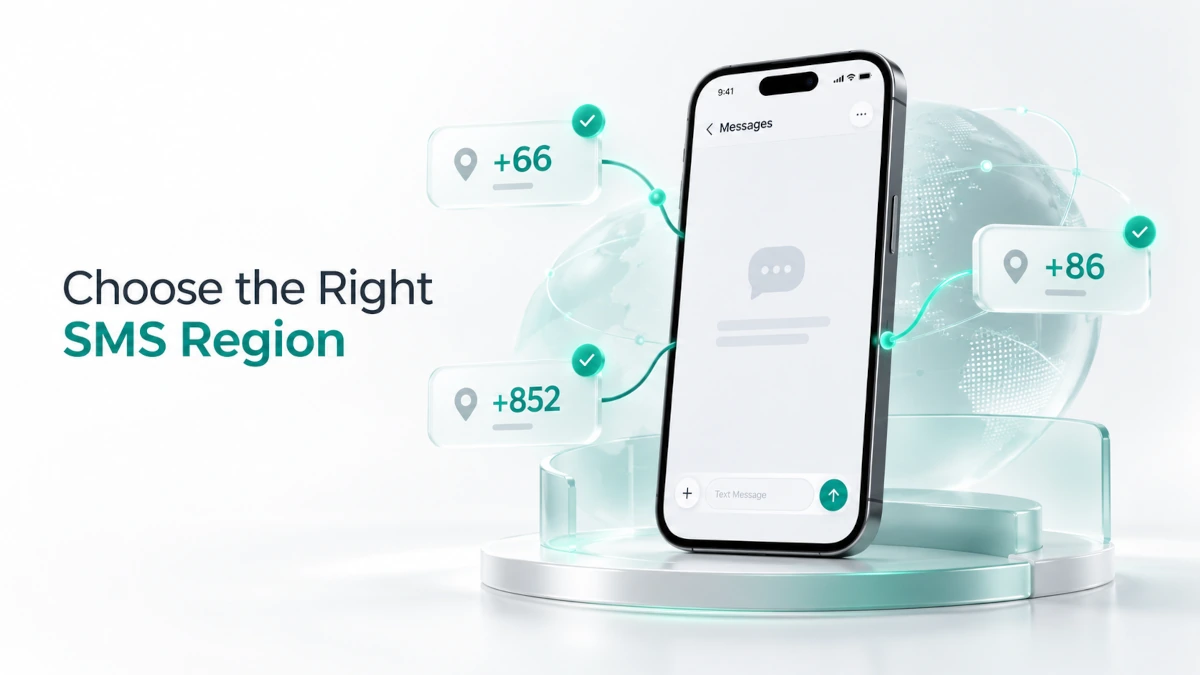
A phone number's country code can affect SMS verification because the sending service may restrict certain destinations, apply regional messaging rules, or require a number associated with a particular market. But the country code alone cannot confirm that an SMS will arrive or that the number will be accepted.
There is no single country code that works best for every application. A valid international number may still be rejected because of the sending platform's rules, its number type, or the messaging route.
Before choosing a temporary number, it helps to understand what the country code actually controls—and what it doesn't.
What Does a Country Code Actually Tell an SMS Verification Service?
A country calling code identifies the numbering plan associated with a phone number. Thailand uses +66, mainland China uses +86, and Hong Kong uses +852.
These prefixes help telecommunications systems interpret and route international numbers. They also give an application a way to identify the number's assigned country or region.
But a country code does not establish the person's current location, nationality, legal residence, or ownership of the number.
Someone traveling abroad may keep their regular home-country number. An international business may legitimately use telephone numbers from more than one market. A temporary-number customer may receive messages through an online inbox without possessing a local SIM card.
Those situations are not equivalent, and a verification service can have different rules for each.
Country code is not the same as account eligibility
An application may accept a +66 number because it supports registrations from Thailand. That does not mean every +66 number is eligible for its verification system.
The service may also consider number type, account requirements, regulatory restrictions, or whether the particular sending route is available.
A country code provides part of the destination information. It is not a verification success certificate.
Four Checks Between a Country Code and a Delivered SMS
A successful verification involves more than entering a number with the correct international prefix.
There are four separate conditions worth examining.
Check | What it determines | Why it matters |
|---|---|---|
Destination permission | Whether the sender permits verification to the selected country or region | A request may be blocked before an SMS is sent |
Number eligibility | Whether the number's format and type meet the application's requirements | A valid phone number may still be rejected |
Messaging route | Whether the sender and telecommunications networks can carry the message to that destination | Accepted requests can still encounter delivery problems |
Receiving access | Whether the intended recipient can view the incoming message during the permitted period | Delivery is not useful if inbox access has expired |
These conditions can fail independently.
A number could be correctly formatted but belong to an unsupported region. A sender could permit the region yet reject the number type. A message could reach the assigned number after the temporary inbox is no longer accessible.
This is why the question “Which country is best?” often has no meaningful answer without knowing the service and receiving arrangement.
The sender can restrict destination countries
Verification systems may allow businesses to configure the countries to which they send authentication messages.
Twilio Verify, for instance, provides geographic permissions for SMS and voice verification. Its documentation explains how a destination may be blocked before verification traffic is sent.
This establishes an important point: a missing code is not always evidence that the receiving number or carrier failed.
It does not establish which restrictions any particular application has configured.
The destination may have different SMS delivery conditions
International application-to-person messaging can involve sender registration, routing rules, carrier filtering, and country-specific regulations.
A sender may support SMS verification in several regions without using identical delivery arrangements for all of them.
Official SMS geographic-permission documentation describes country-specific restrictions and explains why messaging permissions matter.
That is a reason to check supported routes rather than relying on broad claims that one country's numbers always receive codes faster.
A Correct International Number Is Necessary, but Not Sufficient
Many verification forms use the international E.164 number format.
In its common written representation, an international number starts with +, followed by the country calling code and the relevant national number. The international standard allows a maximum of 15 digits, excluding the plus sign.
Number lengths and local dialing rules are not the same everywhere.
Region | Calling code | What the code identifies |
|---|---|---|
Thailand | +66 | Thailand's telephone numbering plan |
Mainland China | +86 | Mainland China's telephone numbering plan |
Hong Kong | +852 | Hong Kong's separate telephone numbering plan |
The table identifies calling codes, not guaranteed SMS-compatible numbers.
Avoid duplicating a country code
Some applications provide a country selector and ask users to enter only the national number.
Others expect the entire international number in one field.
If the form has already selected +66, entering +66 a second time may create an invalid destination. Conversely, removing the country code from a field that requires the complete international number may cause rejection.
Domestic dialing prefixes also vary. A leading digit used for local dialing is not always part of the international representation.
Follow the form's instructions and use the exact assigned number rather than constructing one from a generic example.
Do not confuse format validity with service acceptance
A phone number can be formatted correctly without being active, SMS-capable, or acceptable to the receiving application.
A validation tool may confirm the numbering structure while the sending service applies additional rules.
The country comparison between mainland China +86 and Hong Kong +852 explains how two nearby regions can have different numbering formats and verification requirements.
Does Your Phone Number Country Have to Match Where You Live?
Not always.
Some services accept phone numbers from several countries, including numbers used by international customers or travelers. Others require a particular region for account eligibility, delivery, regulatory compliance, or a local service arrangement.
The deciding factor is the application's official requirement—not a general rule that the number must match your physical location.
When a different country may be acceptable
If a service explicitly supports international numbers, an eligible number from another supported country may be suitable.
That possibility still depends on the number type, verification method, and any account-specific conditions.
A virtual number's country code should not be presented as proof that its user physically resides in that country.
When a different country is not appropriate
If an application requires a local number linked to residency, identity, or another eligibility condition, choosing a foreign or temporary number is not a legitimate substitute for meeting that requirement.
Similarly, changing the phone number's country does not reliably resolve an account restriction, resend limit, or blocked verification session.
Follow the platform's terms and use an officially supported verification method.
Choosing a Temporary Number by Country Without Guessing
The country selection displayed by a number provider is only the beginning of the decision.
A practical approach is to determine what the receiving application permits, identify a compatible route, and check the access period before placing an order.
First: establish the permitted destination
Look for the countries or regions accepted by the service you want to verify.
If a particular country is required, do not substitute another simply because it appears cheaper or has more listed numbers.
If multiple countries are explicitly permitted, there may be several legitimate options to investigate.
Second: check the actual service-and-country combination
A provider may offer numbers from a country without supporting every application through that country's routes.
Check the specific service and country together.
OTP Pool's SMS verification catalogue allows visitors to explore supported service and country options. Availability can change, and a listing does not guarantee that a third-party platform will accept a number or deliver a message.
Third: decide how private and persistent access must be
Country code and inbox access are separate considerations.
A public number can receive real SMS, but its messages may be shared with other visitors. It is appropriate only for non-sensitive purposes where public visibility is acceptable.
A private one-time activation restricts access during the active session but is not a permanent phone number.
A rental can provide continued access during its defined period, subject to its supported capabilities.
If the account may need future SMS verification, the duration and reliability of number access may matter more than the region.
The guide to temporary phone numbers and their limitations explains these access models in more detail.
Fourth: compare available options, not advertised country rankings
There is no independently established universal ranking that makes one country best for every SMS verification service.
Price, stock, country coverage, and the supported route are dynamic. None should be hardcoded into an evergreen guide as a permanent fact.
Use the current service and country pricing only after confirming the region is permitted and the number type is suitable.
Country Examples: Thailand, China, and Hong Kong
Three frequently searched regions illustrate how the same selection process can lead to different answers.
Thailand (+66)
A Thai country code identifies a number from Thailand's numbering plan. It does not by itself establish that an application accepts temporary Thai numbers.
OTP Pool also offers public Thailand SMS inboxes for non-sensitive use. These are shared and should not be used for confidential verification or long-term account recovery.
Before selecting a private Thai number, check the intended service's supported route and requirements.
Mainland China (+86)
The +86 calling code belongs to mainland China. Some services may specifically request a mainland Chinese number.
Where a platform requires +86, a number from another regional numbering plan is not automatically an acceptable replacement.
Review available China SMS number options only after confirming the service's rules.
Hong Kong (+852)
Hong Kong uses +852, which is separate from mainland China's +86.
A Hong Kong number may be suitable when an application accepts that region, but geographic proximity does not make the codes interchangeable.
You can inspect Hong Kong SMS number availability without assuming that every service supports the same route.
These three regions are illustrations of different numbering destinations, not recommendations ranked by price, performance, or success rate.
When Changing Countries Helps—and When It Doesn't
Selecting a different country can sometimes be appropriate, but only when the service allows the alternative region and the original country was a relevant limitation.
Situation | Would changing country help? |
|---|---|
The service explicitly permits another destination country | Possibly, if a suitable number and route are available |
The selected country has no available supported route | Possibly, if another permitted region exists |
The application requires a particular local country code | No; a foreign code would not satisfy that requirement |
The number format is incorrect | Usually no; correct the existing entry |
The service rejects temporary or VoIP number types | Changing the country alone may not address the restriction |
The verification request is rate-limited | No; follow the sender's cool down or recovery guidance |
The assigned number's access period has expired | Check activation or rental options; changing country is not the underlying fix |
Do not repeatedly purchase new numbers to work around an unresolved platform-level restriction.
If a code has already been requested but has not arrived, the more relevant question is where the delivery process failed. The separate guide on verification codes not being received provides a symptom-based troubleshooting process.
Before Confirming a Country Selection
A suitable SMS verification number needs to satisfy several requirements at once.
The sending application must permit the destination region. The number must use a valid format and an accepted number type. An eligible messaging route must be available. Finally, the recipient must be able to access the message when it arrives.
If any of those conditions is unknown, resolve it before assuming a different country will work.
For important accounts, prefer an ongoing recovery method under your control. Public SMS inboxes are shared, while private activations and rentals have limited access periods.
Country codes matter because they influence where a verification message can be sent and how a number is interpreted. They do not replace service eligibility, delivery compatibility, or reliable account access.
Questions and answers
Does the phone number country code affect SMS verification?
Yes. A sending service may permit or block verification messages to particular countries or regions. Number format, number type, SMS routing, and receiving access also affect whether verification can be completed.
Does my phone number country code need to match my physical location?
Not universally. Some services accept international phone numbers, while others require numbers tied to a specific region or account eligibility. Follow the application's requirements rather than assuming you always need to match your current location.
Can I use a different country's virtual number for OTP verification?
Only when the receiving platform supports that country and number type and the workflow is permitted. A foreign number should not be used to misrepresent residency or bypass identity requirements.
Why does a valid country code still fail SMS verification?
A correctly formatted number can still be rejected due to destination restrictions or number-type rules. An accepted request can also encounter delivery delays, routing problems, or expired receiving access.
Which country is best for receiving SMS verification codes?
No country works best for every service. Choose a region accepted by the application, then confirm number eligibility, supported message routing, and the access duration you need. Do not rely on universal country success rankings.
Can a website block SMS verification to a country?
Yes. Some verification providers allow senders to configure geographic permissions and prevent messages from being sent to selected destinations. These settings vary between services.
Is E.164 formatting enough to guarantee SMS delivery?
No. E.164 defines international number formatting. It does not guarantee that the number is active, that the service accepts it, or that a message will pass through the necessary telecommunications networks.
Should I change countries when my verification code does not arrive?
Only if another country is permitted and there is a reason to believe the original destination or route is unsuitable. Changing countries will not fix an account restriction, resend cooldown, or number-type rejection that applies to the replacement.
Sources and references
- List of ITU-T E.164 Assigned Country Codes · ITU Operational Bulletin — Official international country calling-code allocations.
- What is E.164? · Twilio — Explains international telephone number formatting and digit limits.
- SMS Geo Permissions · Twilio — Explains international SMS destination controls and country-specific regulatory considerations.
- Verify Countries and Regions Deliverability · Twilio — Technical documentation of verification availability and geographic deliverability restrictions.