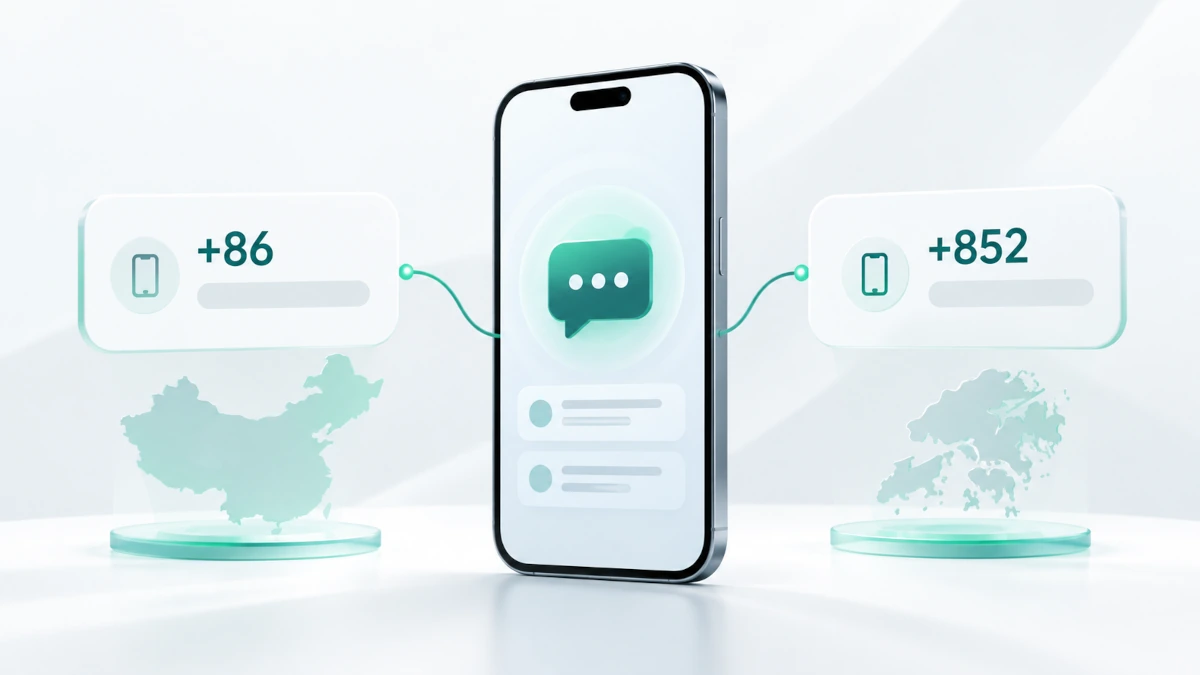
Mainland China and Hong Kong use different international phone-number codes: +86 for mainland China and +852 for Hong Kong. Both can be associated with SMS-capable numbers, but they are not interchangeable for every verification service.
A website may specifically request a mainland Chinese number, accept a Hong Kong number, or restrict particular number types. The correct country code is only one part of a successful SMS verification.
The practical difference is not simply where a number comes from. It is whether the receiving service accepts that region, whether the assigned number can receive the message, and whether you will still control the number when another code is needed.
China +86 vs Hong Kong +852: The Essential Differences
Although Hong Kong is a Special Administrative Region of China, it uses a separate international telephone numbering plan.
Mainland China uses +86, while Hong Kong uses +852. A number registered under one plan does not become a number from the other region simply because both are geographically connected.
Feature | Mainland China | Hong Kong |
|---|---|---|
International calling code | +86 | +852 |
Typical mobile number length after code | 11 digits | 8 digits |
Masked mobile format | +86 1XX XXXX XXXX | +852 XXXX XXXX |
Numbering authority | Mainland Chinese telecommunications authorities | Hong Kong's Office of the Communications Authority |
SMS capability | Depends on the number and route | Depends on the number and route |
Acceptance by online services | Depends on service requirements | Depends on service requirements |
Temporary number availability | Provider-dependent | Provider-dependent |
A service that requires +86 may not accept +852. The reverse can also happen.
A separate issue is whether a platform accepts temporary, virtual, or shared numbers at all. Being located in the requested region does not automatically resolve that restriction.
If you are specifically looking for a number associated with mainland China, explore the available China virtual number options. If the service allows Hong Kong numbers, you can separately check Hong Kong SMS number availability.
These pages display available routes and service information. They should not be treated as guarantees that a particular third-party platform will accept every number.
Understanding +86 and +852 Phone Number Formats
An international phone number contains a country calling code followed by a national number. The E.164 international numbering standard provides the framework for this structure.
The digits following the country code matter. China and Hong Kong have different lengths and allocation rules.
Mainland China: +86 followed by 11 mobile digits
A standard mainland Chinese mobile number generally contains 11 digits, usually beginning with 1.
A masked representation is:
+86 1XX XXXX XXXX
The X characters indicate digit positions, not an actual telephone number.
This representation is specific to the usual mobile format. Mainland landline numbers follow different numbering rules and may include area codes.
When a verification form already has China (+86) selected, it may expect only the national number. Entering +86 again can produce a duplicated country code.
Hong Kong: +852 followed by 8 mobile digits
Ordinary Hong Kong mobile numbers have eight national digits.
A masked representation is:
+852 XXXX XXXX
Hong Kong does not use the mainland Chinese 11-digit mobile numbering structure.
It also has no geographic area code or domestic trunk zero for its ordinary eight-digit numbers. Other categories of Hong Kong numbers can have different formats, so an eight-digit pattern alone does not establish that a number is mobile or can receive verification messages.
Three things to check before entering either number
First, check whether the website has already selected the country code. Second, copy the complete assigned number rather than recreating it from a sample format. Third, follow the website's input instructions for spaces, punctuation, and the international prefix.
A technically valid number format does not prove that the number is active, SMS-capable, privately assigned, or accepted by a particular application.
Can a Hong Kong Number Be Used for Mainland China SMS Verification?
Sometimes, but only when the sending platform supports Hong Kong numbers for that workflow.
The most important distinction is between regional eligibility and technical message delivery.
A platform can allow international numbers but require the user to select the correct country code. Another platform may require a mainland Chinese +86 number for a specific registration or account process.
Even if the service accepts +852, delivery can still depend on the assigned number, the sender's messaging route, network filtering, and the provider's capabilities.
The same principle applies to +86 numbers.
Regional eligibility
Check which countries or regions the service permits during registration or verification.
If the service requires a +86 number, using +852 is not a reliable substitute. Do not misrepresent your residency or identity to bypass a platform's eligibility requirements.
Number-type eligibility
A service may distinguish ordinary mobile numbers from VoIP, shared, temporary, or previously used numbers.
A virtual number is not necessarily VoIP, and a country code alone does not reveal the underlying number type.
Some services restrict certain number categories for fraud prevention or account security. Those restrictions can change.
Actual SMS delivery
A number may pass initial formatting checks but still fail to receive a verification message.
Delivery depends on additional systems, including the sending service, telecommunications routing, provider support, and timing.
This means there are three separate questions: Does the application accept the region? Does it accept the number type? Can the message reach the assigned inbox?
Answering only the first question is not enough.
Public, Private, and Rental Numbers: Which Access Model Matters?
A China or Hong Kong country code tells you where the number belongs in the international numbering system. It does not tell you who can read its messages or how long you can keep access.
Those are separate decisions.
Number access model | Inbox visibility | Duration | Main consideration |
|---|---|---|---|
Public SMS number | Shared or publicly viewable | Provider-dependent | Not suitable for confidential messages |
Private one-time activation | Restricted during the activation | Short-term session | Future SMS access may end |
Rental number | Restricted during the rental | Selected rental period | Access is not necessarily permanent |
Ongoing personal mobile service | Controlled through a continuing service arrangement | While service remains active | Better suited to long-term recovery |
Public numbers can receive genuine SMS, but their messages may be visible to other visitors. They should not be used for financial accounts, confidential communications, or important account recovery.
You can review how public SMS inboxes work, keeping in mind that public access is fundamentally different from a private activation.
A private number limits who can access messages during an active order, but it does not guarantee permanent ownership.
A rental can help when repeated SMS reception is needed within a specified period. It is still important to check what happens when the rental ends.
For long-term accounts, use a recovery method you can reliably maintain rather than depending on a temporary number that may later become unavailable.
How to Choose the Right Number: A Three-Part Decision
Instead of choosing between +86 and +852 based only on price or a provider's availability list, start with three questions.
1. Region: Which country code does the service actually accept?
Look at the receiving application's official requirements.
If it asks for a mainland China number, investigate the +86 route. If it permits a Hong Kong number, +852 may be an option.
If the service accepts multiple countries, the country code alone does not establish which route will deliver more reliably.
2. Message access: Who needs to see the incoming SMS?
For a non-sensitive, authorized test, a public inbox may be acceptable when shared visibility is understood.
For a private verification workflow, the inbox should not be openly accessible.
Review the provider's privacy, retention, and number-access policies before using a temporary number.
3. Future access: Will another code be needed later?
This is often the deciding question.
An application may request SMS verification again after a password change, a security check, a new device login, or account recovery.
A one-time activation is unsuitable when you need dependable access to the same number over an unknown future period.
Where supported, compare temporary activation options with longer-access alternatives before committing to a number.
The best choice is the number that meets the application's requirements and your future access needs—not automatically the cheapest or the shortest-lived option.
Why China or Hong Kong SMS Verification Codes May Not Arrive
A missing SMS does not necessarily mean the country code is incorrect.
Several independent conditions can prevent a message from reaching an online inbox.
Incorrect number entry
A duplicated country code, missing digit, unsupported punctuation, or wrongly selected region can cause immediate rejection.
Check the exact assigned number against the application's input requirements.
Unsupported verification route
Some services accept a phone number's format but do not deliver messages to particular virtual, shared, or carrier routes.
If the sending platform does not support the number type, repeatedly requesting another SMS may not resolve the problem.
Sender restrictions and retry limits
Applications may apply anti-abuse checks, delivery restrictions, or rate limits.
Repeated requests can cause additional delays or temporary blocks. Follow the sender's official retry instructions and wait for any displayed cooldown.
Provider or network delivery problems
Telecommunications routing issues, sender filtering, temporary provider interruptions, and inactive assignments can also affect delivery.
A country-specific number being listed as available does not mean an incoming SMS is guaranteed.
Expired number access
A message requested after the assigned access window ends might not appear in your inbox.
Check the activation status and expiry time before asking the sender to issue another code.
If a message still does not arrive, consult the provider's support and refund conditions rather than assuming that switching from China to Hong Kong will solve the issue. The OTP Pool help center provides guidance on route selection and message-delivery problems.
Privacy, Regional Restrictions, and Long-Term Account Safety
Using a secondary number can reduce how often you disclose your personal mobile number, but it does not make you anonymous.
The receiving website may still process your email address, device information, account identifiers, and other data. Number providers may also maintain operational records under their own policies and legal obligations.
Do not infer a person's location, legal residence, identity, or physical SIM ownership solely from a +86 or +852 number.
For temporary-number users, the greater practical risk may be what happens after access ends.
If an account remains linked to a number that you can no longer receive messages on, later sign-in or recovery attempts may fail. A number may also be reassigned, depending on the provider's lifecycle.
Avoid shared inboxes for sensitive accounts. Follow applicable laws and the receiving platform's terms, and use an ongoing phone service or another approved recovery method whenever lasting account control matters.
What to Check Before Selecting +86 or +852
Mainland China and Hong Kong have separate numbering plans, different normal mobile-number lengths, and potentially different acceptance conditions on third-party platforms.
Choose the region required by the application. Then check whether the provider supports the relevant messaging workflow, whether inbox access is private or shared, and whether you need that same number again.
If a service accepts either region, do not assume one will be faster, cheaper, safer, or more reliable in every case. Those characteristics depend on the specific route and current conditions.
The decision is complete only when region, message access, and future access all match your intended use.
Questions and answers
Are +86 and +852 the same country calling code?
No. +86 belongs to mainland China's telephone numbering plan, while +852 belongs to Hong Kong's separate numbering plan. A service requiring one code may not accept the other.
Can I use a Hong Kong phone number for China SMS verification?
Only if the service supports Hong Kong numbers for that verification process. Some services require mainland China (+86), while others accept multiple regions. Acceptance also depends on number type and the service's security rules.
How many digits are in a China mobile number?
Mainland Chinese mobile numbers generally contain 11 national digits after the +86 country code. Their usual format is represented as +86 1XX XXXX XXXX, with X indicating masked digit positions.
How many digits are in a Hong Kong mobile number?
Ordinary Hong Kong mobile numbers contain eight national digits after +852, commonly written as +852 XXXX XXXX. The number must also belong to an appropriate mobile allocation to support the intended service.
Which is better for SMS verification: +86 or +852?
Neither is universally better. Choose the country code accepted by the receiving service, then check the number type, supported SMS route, privacy model, and required access duration. Availability does not guarantee message delivery.
Can a temporary China or Hong Kong number receive another verification code later?
That depends on the access model. One-time activations generally have limited receiving windows, while rentals may support repeated messages during the rental period. Neither automatically guarantees permanent control or future account recovery.
Are public China or Hong Kong SMS inboxes private?
No. Messages displayed through a public shared inbox may be visible to other visitors. Avoid using public numbers for banking, personal accounts, password resets, or confidential information.
Sources and references
- List of ITU-T E.164 Assigned Country Codes · ITU Operational Bulletin — Confirms the international country calling codes assigned to mainland China and Hong Kong.
- ITU Operational Bulletin No. 1157 · International Telecommunication Union — Documents numbering allocations and 11-digit mainland Chinese mobile number resources.
- Access Codes for Mobile Networks Used with the E.164 Country Code · ITU Operational Bulletin — Provides telecommunications numbering and mobile allocation context.
- The Numbering Plan for Telecommunications Services in Hong Kong · Office of the Communications Authority, Hong Kong — Official reference for the allocation and structure of Hong Kong telephone numbers.